
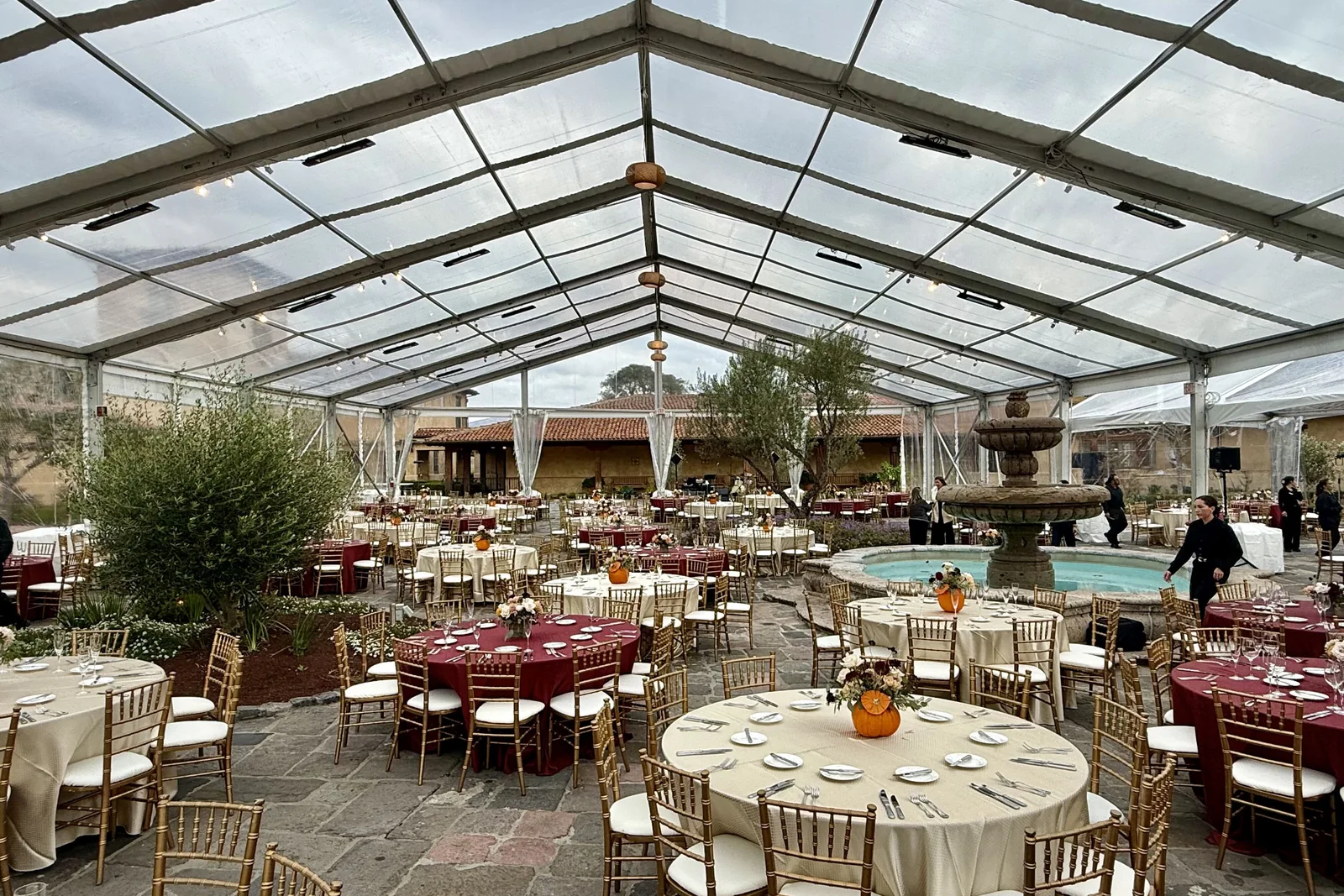
The Monterey Peninsula hosts major events throughout the year, from Car Week and race weekends at WeatherTech Raceway Laguna Seca to the AT&T Pebble Beach Pro-Am. The setting is part of the experience. It also affects how a tented environment needs to be planned.
The questions we hear early are practical: what does this particular site need, which agencies will review it, and when should the planning start?
Start with the actual site
An exposed coastal fairway, a sheltered space beside a clubhouse and an inland venue can present different conditions. Engineering needs to address where the structure will sit and how it will be used.
Site exposure can affect the structure configuration, anchoring approach and available footprint. Access, ground conditions and the venue’s restrictions also belong in that discussion. Review those details with the structure team and the responsible engineer before treating an earlier layout as a ready-made answer.
Send the site address or a map pin with the first inquiry. Include photographs and any venue drawings you already have.
Identify the right permit route
Start with the authority responsible for the actual address. Unincorporated county sites and incorporated cities can follow different processes, and the fire authority may have its own review.
California’s 2025 Building Standards Code took effect on January 1, 2026. Ask the reviewing agencies which current requirements apply to the proposed installation.
Monterey County publishes different routes for temporary tents, with eligibility affected by size, duration, mechanical systems, raised platforms and configuration. Its tent-permit policy is a starting point for that conversation.
Prepare to discuss:
The site plan, structure placement and proposed use.
Guest numbers, seating, circulation and exits.
Required engineering and manufacturer information.
Cooking, power, climate control and specialist responsibilities.
Accessible routes, entrance transitions and facilities.
Fabric identification, flame-resistance labels and any documentation requested by the fire authority.
Keep the required labels and paperwork available for inspection. Confirm what the approving agency will accept rather than assuming one certificate or a previous approval covers every installation.
Work backward from the event date
The county’s special-event guidance calls for construction-permit applications at least 60 days before an event to avoid additional fees and warns that applications within 30 days may not be processed. Confirm the current deadline and fees with the responsible agency.
For a complex build, start the discussion earlier. Choura’s recommendation is to work toward a settled layout and guest count roughly 90 days out where possible. Engineering, venue review and supplier coordination all need room in the schedule. A raised deck, cooking area or longer installation can introduce further questions.
Include installation, inspection, event operation and strike dates. The event’s opening time is only one milestone.
Carry forward what you learn at each venue
Working repeatedly at Pebble Beach and Laguna Seca helps our team recognize access, layout and scheduling questions early. Previous drawings can be a useful reference, but changes in the site, configuration or applicable requirements still need review.
Walk the site with the venue team. Check slopes at entrances, the delivery route and any proposed hospitality area that could conflict with access needed elsewhere. Agree when inspections can take place and who needs to be present.
The goal is to resolve those relationships while there is still time to change the plan.
What to share with the Northern California team
Site address or map pin.
Guest count and how the space will be used.
Required structures, flooring and any raised platforms.
Power, cooking, climate control or other specialist needs.
Installation and strike dates.
Venue contact and the person responsible for permit coordination.
Our Northern California team would rather discuss the site early than discover a constraint just before load-in. Talk with the Northern California team about the date, location and experience you want to create.
Source checked: California Building Standards Commission, together with the county guidance linked above. Requirements depend on the proposed installation and the reviewing authority.